
Grid Efficiency: The Hidden Climate Lever
The Electricity That Never Arrives
We spend billions building new power plants — solar farms, wind turbines, nuclear reactors. But a significant fraction of the electricity they generate never reaches end users. It is lost as heat in transmission lines, transformers, and distribution networks.
Globally, transmission and distribution (T&D) losses account for an estimated 8-9% of all electricity generated. But the variation between countries is enormous.
The Best and Worst Performers
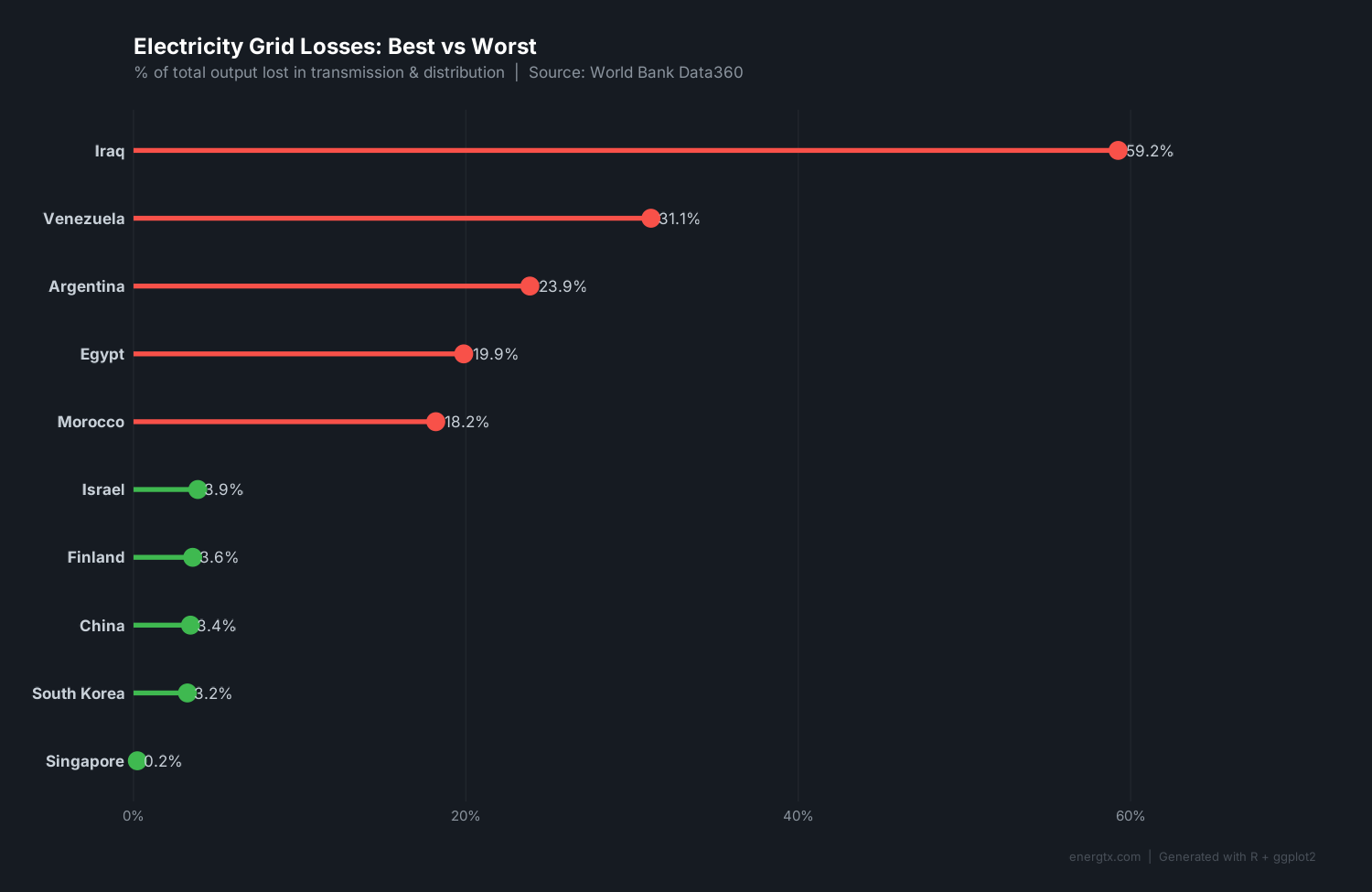
The data reveals striking disparities:
Highest Losses
| Country | Losses (% of output) | |---------|---------------------| | Iraq | 59.2% | | Venezuela | 31.1% | | Argentina | 23.9% | | Egypt | 19.9% | | Morocco | 18.2% |
Lowest Losses
| Country | Losses (% of output) | |---------|---------------------| | Singapore | 0.2% | | South Korea | 3.2% | | China | 3.4% | | Finland | 3.6% | | Israel | 3.9% |
Iraq loses 59% of its generated electricity before it reaches consumers. This means the country would need to nearly double its generation capacity just to deliver the same amount of useful electricity as a country with efficient grid infrastructure.
Why Grid Losses Matter for Climate
The Carbon Math
Every unit of electricity lost must be replaced by generating more. In fossil-fuel-dependent grids, this means burning more coal or gas. Reducing Iraq's grid losses from 59% to even 20% would be equivalent to building massive new renewable capacity — without installing a single solar panel.
The Investment Case
Grid modernization is often less glamorous than building new generation capacity, but the economics are compelling:
- High-voltage direct current (HVDC) transmission lines can cut long-distance losses by 30-50%
- Smart grid technology reduces distribution-level losses through better load management
- Underground cables in urban areas reduce weather-related outages and losses
What Explains the Differences?
The gap between Singapore (0.2%) and Iraq (59%) reflects several factors:
- Geographic scale: Singapore is a city-state; Iraq spans vast distances with aging infrastructure
- Investment levels: Countries with well-maintained, modern grids (South Korea, Finland) consistently show low losses
- Political stability: Conflict and underinvestment in grid maintenance drive losses in Iraq and Venezuela
- Grid voltage: Higher transmission voltages reduce resistive losses
China's Grid Efficiency
China's 3.4% loss rate is remarkable given the country's continental scale. This reflects massive investment in ultra-high-voltage (UHV) transmission lines — some spanning over 3,000 km — that efficiently move electricity from western generation centers to eastern demand centers.
Explore the Data
Grid loss data, along with electricity generation, capacity, and pricing data for 56 countries, is available on energtx.com. Download in JSON, CSV, or XLSX for your own analysis.
Before building the next power plant, fix the grid that delivers the power.
Methodology
Transmission and distribution loss data sourced from World Bank Data360 (most recent available year per country). Values represent electricity lost as a percentage of total output. Visualizations generated with R and ggplot2.